

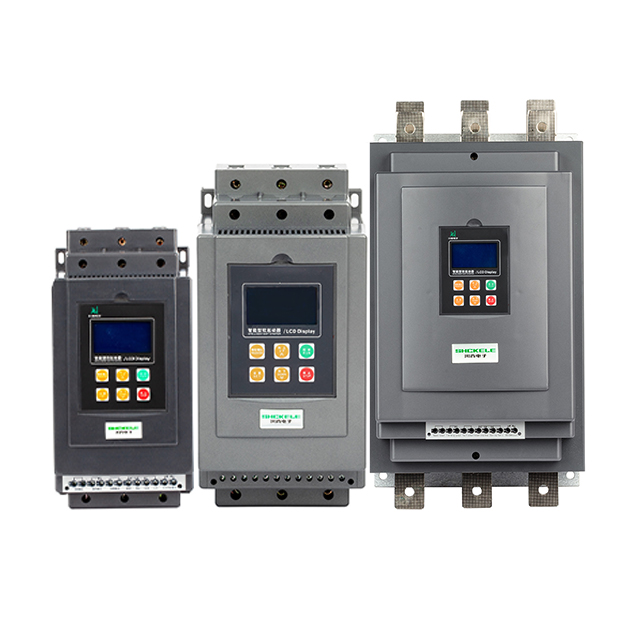
A Bypass Soft Starter is a state-of-the-art motor controls device that uses power electronics, microprocessors, and advanced control theory. It allows for soft starting of a demanding electric motor used in equipment like fans, pumps, conveyor belts, and compressors by raising voltage in a controlled manner—avoiding the mechanical and electrical stress associated with conventional starting methods.
Upon activating, the soft starter slowly and steadily increases voltage in line with a set ramp-up time (which is set between two seconds to as much as 60 seconds). Once the motor is fully operational, using a built-in contactor or an external one, the load will be moved to the motor directly alongside mains supply as there is no need for the soft starter to play any role in this process.
Core Technology and Features
The innovative power electronics and microprocessor control technology is used in Bypass soft starters to assure motor automation accurately. The most important technical features of the soft starter are:
- Main circuit voltage: AC 380–1140V (with -10% to +15% tolerance)
- Main current rating: 11A to 1500A
- Supported frequencies: 50Hz/60Hz (±2%)
- Soft start/stop time: 2–60 seconds
- Current limiting factor: 1.5–5.0 times rated current (Ie)
- Initial voltage: 30%–70% of rated voltage (Ue)
- Cooling mode: natural cooling
- Supported communication: RS485 serial
- Start frequency: up to 10 starts/hour
These characteristics allow bypass soft starters to be tailored to different load requirements and the environment of installation so that versatility and safety can be guaranteed in different operations.
How Does a Bypass Soft Starter Work?
When activated, power electronic elements (SCR, thyristor) gradually increase the voltage supplied to the motor until it reaches target speed within the set ramp-up time. Current demand is typically limited to about 1.5–5 times rated current, minimizing inrush and protecting the electrical system.
After this initial phase, a bypass contactor (internal or external) connects and routes power directly to the motor, bypassing the starter circuit. This allows efficient operation, reduces energy expenditure, and minimizes motor wear from overheating and current changes. Soft stops can also be programmed for smooth slow-downs, eliminating mechanical shocks in conveyor or pump applications.
Applications of Bypass Soft Starters
Bypass soft starters can be used for heavy-duty equipment. The advantages of these devices can be seen in:
Fans and Blowers: HVAC systems rely on soft starters to avoid unexpected airflow surges and to safeguard ductwork and fans from sudden stress.
Pumps (Water, Wastewater, Irrigation): Pipeline systems and valves avoid damaging pressure variations and water hammer through controlled starting and stopping.
Conveyors and Material Handlers: Soft starters help the duration of belts and gear systems by being able to prevent jerk loads and slippage.
Compressors: Smooth voltage ramp-up eliminates torque spikes, decreases wear and tear on components, and prolongs the lifespan of compressors.
Furthermore, these systems gain more from the traits like RS485 serial communication, which aids in advanced monitoring from remote locations, thus helping to connect and interface with different control systems within factories.
Choosing the Right Bypass Soft Starter
To choose the most suitable bypass soft starter, consider:
Rated Voltage and Current: Verify the start ratings correspond to your specifications for instance AC 380~1140V & 11A to 1500A. It is crucial to watch the maximum number of starts within the hour, as many of these products are capable of making up to 10 starts per hour.
Load Profile and Duty Cycle: Determine if your application calls for frequent startups, high current limitation, or long ramp times.
Start/Stop Timing: The option to modify both the soft start and soft stop times from 2 to 60 seconds allows for a personalized approach to the response of machinery to the process, which helps to reduce the impact incurred on equipment and electrical network.
Integrated Features: With the help of its built-in bypass contactors, the installation and maintenance of the complete system is carried out more simply.
System Integration: Communication interfaces like RS485 allow for connection with PLCs and central control systems, which play an important role in the current industry.
Common Problems and Troubleshooting Tips
Bypass soft starters are designed for reliability but may occasionally encounter issues:
Startup or Bypass Failure: Worn-out contactors, faulty electrical wiring, or excessive number of starts can also lead to this problem. Make sure that the starting frequency guidelines (i.e. not more than 10 starts per hour) will not be exceeded, and that all the connections are tight.
Overheating: Extended duration in start mode and high ambient temperature could lead to overheating. For this consider checking the cooling airflow and ensuring that the bypass contactor is activated.
Communication Errors: In case of integration access errors, the connection points must be checked for any data cable degenerate or incorrect settings.
Unexpected Trips or Alarms: Configuration errors involving current limiting, ramp time, or initial voltage can result in nuisance tripping. Examine your configuration to ensure it properly matches the motor and load.
Regular maintenance and implementing the operating instructions given by the manufacturer can help decrease such problems and keep the equipment operating efficiently.
Frequently Asked Questions
Does the soft starter keep running after the motor reaches full speed?
No. The bypass contactor transfers the load directly to the mains, so the starter’s power electronics stop carrying current, reducing heat and extending life.
Can it support remote monitoring?
Yes. RS485 communication allows integration with PLCs and central control systems for remote monitoring and fault diagnostics.
How do I know if the bypass contactor has failed?
The motor may start softly but then trip or lose power instead of reaching full speed. Check for worn contacts, loose wiring, or excessive start frequency.
The Bypass Soft Starter is a modern-day technology intended for effective operation of industrial motors. This most efficient device is designed to ensure smooth and safe start-up and shut-down of electric motors, protect costly equipment from damage due to excess current and mechanical stress, and provide monitoring of operation if needed. If purchasers and engineers know the basic unique technical specifications and application schemes, they can very successfully select and set up transport soft starters to improve the efficiency and safety of the operation of motors.
Post time: Oct-22-2026