

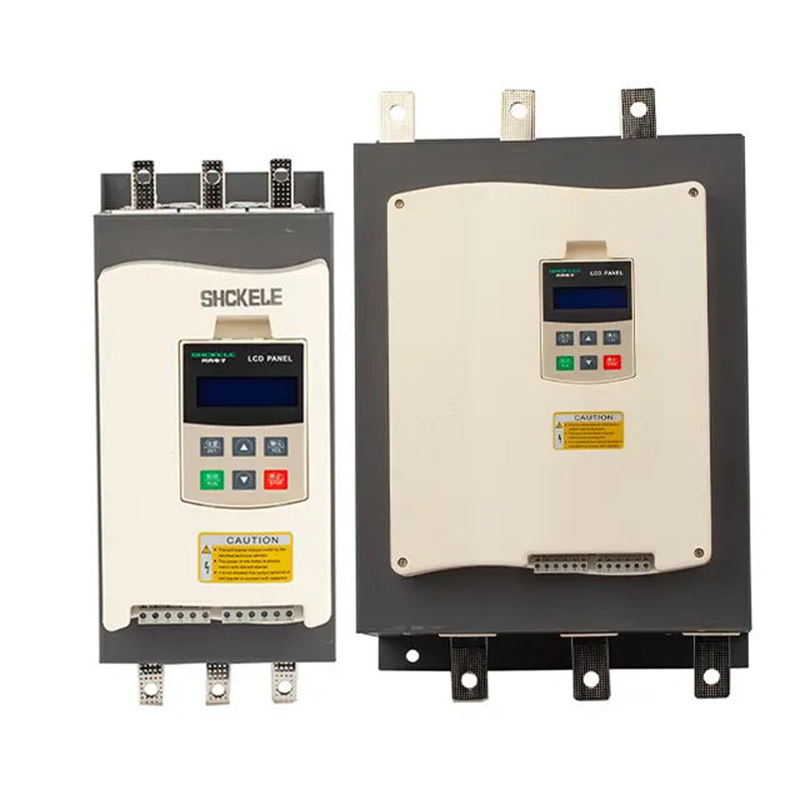
If you work with industrial motors, you’re familiar with the jarring start of a large motor lights dimming, machinery jerking, and stress on the system. A common solution is the Soft Starter. In simple terms, it’s an electronic device that controls the voltage supplied to an AC motor during startup and shutdown. Its core job is to provide a smooth, controlled ramp up to full speed rather than an abrupt, full power jolt think of it as a gentle push instead of a forceful shove.
Why is a Soft Starter Needed? The Problem It Solves.
During across-the-line starting, an AC motor starts 6 to 10 times its rated current, resulting in significant inrush current and related issues:
·Mechanical Stress: Sudden high torque can damage connected equipment such as belts, gears, and conveyors, accelerating wear.
·Electrical Stress: High current overheats motor windings and causes voltage dips, disrupting other sensitive devices on the same supply.
·Operational Impact: Conveyed items may tip, fluid systems can experience water hammer, and the entire system undergoes unnecessary shock.
A Soft Starter directly addresses these issues by gradually increasing the voltage to the motor, allowing it to accelerate smoothly and limiting the inrush current.
How Does a Soft Starter Work?
A soft starter employs silicon controlled rectifiers (SCRs), or thyristors, which function as high-speed switches to “chop” the input voltage waveform. During startup, it permits only a portion of the voltage to pass and gradually increases it over a configurable ramp time—typically adjustable from seconds to tens of seconds—until the motor reaches full speed and line voltage. It similarly provides a controlled voltage decrease during shutdown to prevent abrupt stops.
Key Benefits of Using a Soft Starter
1.Reduced Mechanical Stress: The primary benefit. By controlling acceleration, it drastically decreases stress on shafts, couplings, and driven machinery, extending their service life.
2.Limited Inrush Current: Protects your electrical infrastructure by preventing damaging current spikes and voltage sags.
3.Smooth Operation: Eliminates jerky starts and stops, leading to more stable processes and better product handling.
4.Simple and Cost-Effective: Compared to solutions like Variable Frequency Drives (VFDs), a soft starter is simpler and more economical when only controlled startup and shutdown are required, without the need for continuous speed adjustment.
Common Applications: Where You’ll Find Soft Starters
A soft starter is commonly used where motors start under load, run at constant speed, and starting shock must be minimized. Typical uses include:
·Conveyor belts and material handling systems
·Large fans and blowers
·Centrifugal pumps (to reduce water hammer)
·Compressors
·Crushers and grinders
Soft Starter vs. VFD: A Quick Clarification
It’s important not to confuse a Soft Starter with a Variable Frequency Drive (VFD). While both manage motor starting, a VFD’s main function is to control the motor’s speed continuously during operation by varying its frequency. A Soft Starter only manages the start and stop phases; once the motor is at full speed, it runs directly on the main power line. If you only need to solve startup problems, a soft starter is the efficient choice. If you need to vary speed for process control, you should look at a VFD.
Conclusion
A Soft Starter is a protective device designed to solve one key problem: the damaging impact of sudden motor starts. By delivering controlled, smooth acceleration, it reduces mechanical wear, minimizes electrical stress, and enhances overall system reliability. If your primary aim is to protect equipment from startup shock while maintaining constant operating speed, a soft starter is a practical and effective solution.
Post time: Jan-03-2026