

In industrial electronic systems, making sure that everything runs smoothly and properly for a long time is extremely important. One main device that plays an important role here is a three-phase soft starter. This article will discuss the working principles, types and advantages of the soft starters, giving interesting information to those who want to buy it as well as to professionals in the industry.
What Is a 3 Phase Soft Starter?
A 3 Phase Soft Starter is an electrical device that reduces starting current and smoothly increases the voltage while starting a 3-phase motor. Unlike standard direct-on-line starters which apply full voltage instantly, these devices gradually increase the voltage and current to the motor reducing mechanical stresses and electrical surges.
How 3 Phase Soft Starters Work
The workings of a three-phase soft starter consist of controlling the voltage supplied from the motor when starting and stopping the processes. Thyristors are normally used for achieving the purpose. The task layout consists of powering the motors with some minimal voltage in the beginning of the process, and then gradually increasing the voltage till the motor runs on its nominal voltage. This allows for the reducing of the start currents that are usually damaging for the machines and connected devices.
Moreover, while decelerating process, the soft starter is able to perform a controlled ramp-down process, which enables the motor to wind down gradually rather than abruptly stopping. This characteristic may greatly prolong the lifetime of both the motor and the equipment connected to it.
Types of 3 Phase Soft Starters
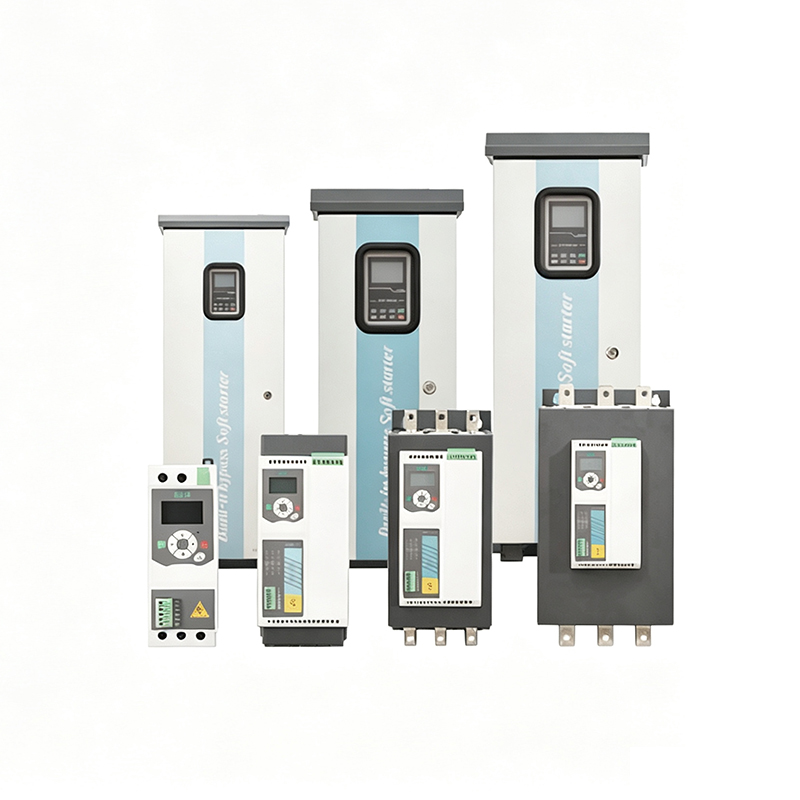
There are primarily two types of 3 Phase Soft Starters available in the market:
1. Soft Starters: These are the entry level versions used for simple applications where the need is for minimal starting current and gradual speed ramping.
2. Compact Soft Starters: The Compact Soft Starter for 3-phase Installation is meant for limited spaces and applications that have space restriction while functioning in the same way. The Compact Soft Starters find extensive applications in cases where space is a big factor.
Key Benefits of Using Soft Starters
The incorporation of soft starters in industrial settings brings several benefits, including:
- Soft starters minimize the amount of starting current allowing them to prevent problems such as electrical failure or circuit breaker loss.
- Soft starters can significantly increase the life of motors and their connected equipment by lowering the mechanical stress during start and stop operations.
- Higher Efficiency: Continuous acceleration results in enhancing the performance of the motor and load connected which leads to better energy efficiency.
- Adaptable Control: Soft starters can be programmed to accommodate multiple applications, offering start and stop profiles that can be tailored to specific operating needs.
Conclusion
3 Phase Soft Starters act as crucial devices in controlling 3-phase motors. These tools provide smoothing in the process of acceleration or deceleration minimizing the stress exerted upon the machines and ensuring their reliability in demanding industries. The selection of standard or compact versions allows fulfilling different needs of the users with respect to operating results. The investments in soft starters allow reducing downtime and maintenance costs.
Post time: Aug-25-2026