

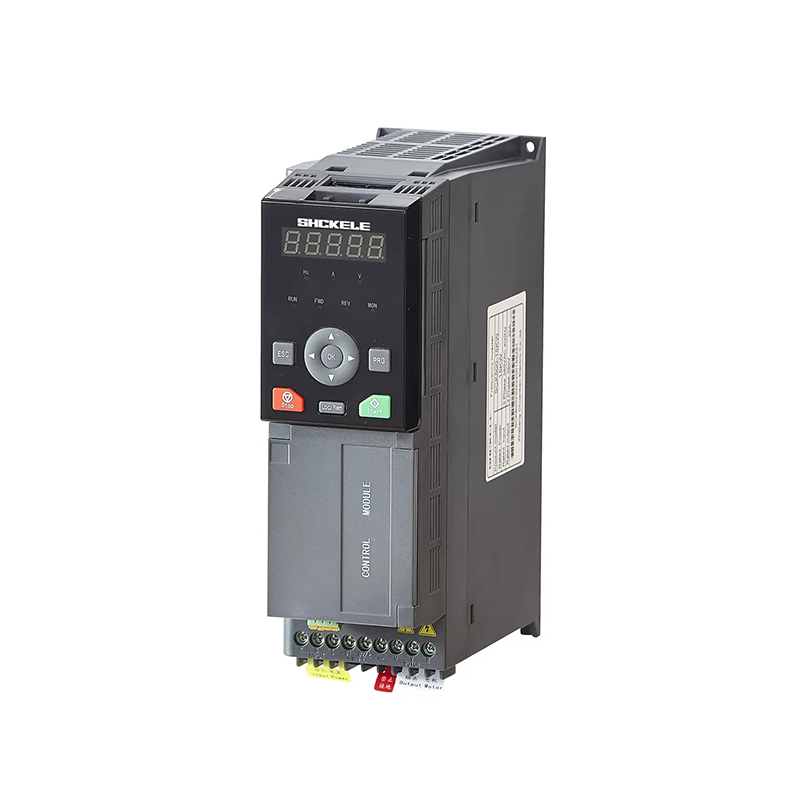
A frequency inverter adjusts the speed of an AC motor by varying the frequency and voltage of its supply. Instead of running at fixed mains frequency, the motor can operate at any speed within its range on demand. The immediate gain is energy savings a motor at 80 percent speed uses less power than one throttled by a damper or valve at full speed. It also provides softer starting, reduces mechanical shock to couplings and belts, and matches output to process needs without changing pulleys or gear ratios.
How the Conversion Process Works
The internal stages of a frequency inverter are simple: an input rectifier converts incoming AC to DC, a DC-link smooths the voltage with capacitors, and an output inverter stage using high-frequency IGBTs reconstructs an AC waveform at the desired frequency and voltage. The motor sees a synthesized AC supply, and shaft speed follows the frequency.
Control strategy makes the difference. Sensorless vector control calculates rotor position from measured current and voltage, delivering tight speed regulation and high starting torque without an encoder. Closed-loop vector control with encoder feedback adds full torque at zero speed and servo-like precision from a standard induction motor. For fans, pumps, and loads where speed accuracy is not critical, the simpler V/f control that maintains a constant voltage-to-frequency ratio remains the economical choice.
Where Frequency Inverters Change Process Economics
A frequency inverter pays back fastest when it replaces a throttling method of flow or speed control. Common application areas include:
●Pumps and water distribution: A pump at reduced speed uses far less energy than one throttled at full speed. Pressure setpoint control matches speed to demand, so a booster station only draws the power needed at each moment.
●HVAC fans and compressors: Variable speed on supply fans, return fans, cooling tower fans, and chiller compressors cuts energy and reduces duct pressure noise by replacing inlet vanes or discharge dampers with a frequency inverter.
●Conveyors and material handling: Different products need different speeds. A frequency inverter provides that without mechanical variators or belt changes, and soft-start ramps prevent the shock that disrupts product alignment.
●Mixers, agitators, and centrifuges: Batch processes ramp speed by recipe step. A frequency inverter controls the ramp and holds target speed as viscosity shifts during mixing.
●Cranes and hoists: High starting torque holds the load at standstill, and controlled acceleration prevents swing. A frequency inverter with vector control and brake output replaces multi-speed motors and contactor-resistor starters.
●Textile and printing machinery: Multiple drive sections maintain precise speed ratios through electronic synchronization, eliminating mechanical line shafts.
Sizing a Frequency Inverter for the Actual Load
The most common sizing error is matching inverter nameplate power to motor nameplate power without checking the actual load profile. A pump starting against a closed valve draws less current than one starting into an empty pipe. A high-inertia centrifuge needs more overload capacity to accelerate within an acceptable time. A conveyor starting fully loaded in the cold draws more than one starting empty at ambient. Size the frequency inverter for continuous current under worst-case conditions, not just rated full-load current, and leave overload headroom 150 percent for 60 seconds on heavy duty, 110 percent on light pump and fan work. Too little margin causes nuisance tripping during normal process variations.
Installation Factors That Determine Reliability
Heat and contamination are the main threats to frequency inverter electronics. Keep the ambient temperature within rated limits typically 40 to 50 degrees Celsius without derating with adequate ventilation or forced cooling. A sealed enclosure without airflow forces output derating or early capacitor failure.
Harmonics from the input rectifier flow back into the supply network. On weak supplies or multi-inverter sites, this can distort voltage and affect other equipment. Line reactors, active front-end rectifiers, or built-in DC-link chokes reduce harmonics and improve the supply-side power factor.
Long motor cables matter because high-frequency switching creates voltage reflections that can double the voltage at the motor terminals, stressing winding insulation. Beyond roughly 50 meters, add a load reactor or dv/dt filter at the inverter output, or use inverter-duty motor insulation rated for the higher stress.
Commissioning Steps That Pay Back Immediately
Enter motor nameplate data accurately voltage, current, frequency, speed, and power factor so the inverter can build the motor model. On vector-controlled drives, run the auto-tune routine to measure stator resistance and magnetizing characteristics; this gives accurate torque at low speed. Set acceleration and deceleration ramps to match the mechanical load too fast trips overcurrent or overvoltage, too slow wastes cycle time. Minimum and maximum frequency limits prevent damaging operation, like running a fan below the speed where bearings depend on airflow for cooling. The inverter can also provide motor thermal protection by calculating the motor’s thermal state from current and frequency, accounting for reduced cooling at low speeds. On self-cooled loads like fans, this model catches a slow overheat that a standard current relay would miss.
Maintenance That Prevents Unplanned Downtime
A frequency inverter has no bearings or belts, but components with finite life still need attention. DC-link capacitors degrade over years, faster at higher temperatures; scheduled replacement at the manufacturer’s interval typically five to ten years prevents an unexpected failure that takes the inverter offline. Cooling fans run whenever the inverter is powered, and worn bearings lead to overheated heatsinks and degraded semiconductors. Check fans for free spin and noise during scheduled service. Power terminals loosen from thermal cycling, so re-torque them annually a loose connection develops resistance heating that can melt terminal blocks or damage internal buswork. A thermographic scan under full load catches loose connections before they fail.
A Technology That Earns Its Place on the Factory Floor
A frequency inverter turns fixed-speed AC into adjustable motor control, changing how a motor starts, runs, and draws energy. On pumps and fans, the energy saving alone often recovers the cost within months. Softer starting reduces stress on belts, couplings, and bearings, while electronic speed control replaces mechanical throttling via valves or dampers. For any constant-speed motor regulated by restriction, a frequency inverter brings savings that show on both the energy bill and the maintenance schedule.
Post time: May-12-2026