

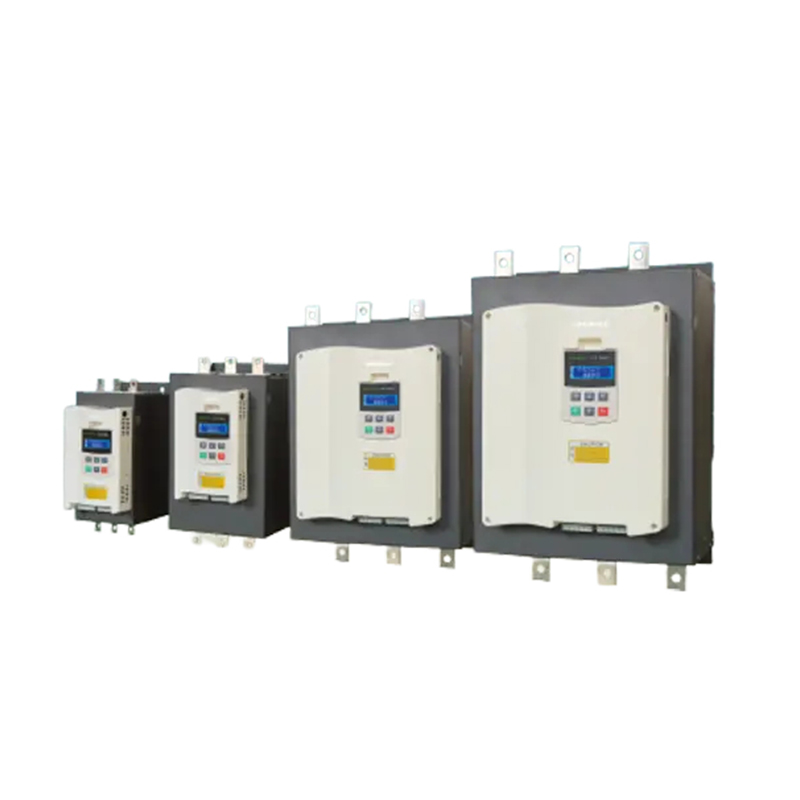
A motor soft starter gradually ramps up voltage to AC induction motors, lowering inrush current and mechanical impact caused by direct-on-line starting. Instead of drawing 5–7 times full-load current instantly and damaging couplings, belts and gearboxes, it accelerates the motor steadily over seconds by slow voltage rise, only supplying enough current to overcome load inertia.
How SCR-Based Voltage Ramp Works
A motor soft starter adopts inverse-parallel SCRs per phase. The control board adjusts the SCR firing angle to regulate output voltage: delaying the angle lowers voltage, while gradual advancement raises voltage to full level for smooth motor acceleration.
After startup, a bypass contactor closes to bypass the SCRs, cutting heat and power loss; the motor then runs at full voltage, with the soft starter only functioning during start and optional soft stop.
This open-loop voltage control does not monitor speed or frequency, and torque drops as voltage reduces. It works well for centrifugal pumps and light fans with low low-speed torque. But for heavy loads such as loaded conveyors and crushers, simple voltage ramp may lack enough starting torque, leading to motor stall or overload tripping.
Application Scope of Motor Soft Starter
Choosing between a motor soft starter, DOL starter and VFD depends on actual application demands:
●Centrifugal pumps: Direct startup causes pressure surges that damage check valves and pipe supports. Soft starting eliminates water hammer and reduces starting current, enabling stable startup even with weak power supply or standby generators.
●Fans and blowers: Direct startup easily leads to belt slipping, noise and duct vibration. A motor soft starter realizes steady acceleration, protecting belts and reducing maintenance.
●Lightly loaded conveyors: Empty or half-load conveyors adapt well to voltage ramp startup, avoiding sudden jolts that shift materials or cause belt deviation.
●Compressors: Unloaded rotary screw compressors only need low breakaway torque, which can be perfectly matched by soft starter voltage ramp control.
●Heavy crushers & fully loaded conveyors: Such loads require high breakaway torque. Ordinary soft starters may cause stall; in this case, VFD is more suitable, or configure the soft starter with higher initial voltage and faster ramp time.
●Transformer & generator limited sites: The reduced starting current of a motor soft starter avoids voltage dip, facility undervoltage or generator stall when the power supply capacity is limited.
Key Startup Parameter Settings
Initial Voltage: Determines initial starting torque. 25%–35% line voltage fits most pumps and fans. Too low causes motor idling and winding overheating; too high loses soft start effect.
Ramp Time: Controls the duration from initial voltage to full voltage, commonly 5–15 seconds for pumps. Excessively long ramp keeps motor in high-slip state and triggers thermal trip; set the shortest acceptable ramp based on mechanical tolerance and thermal limit.
Current Limit: Automatically suppresses voltage once current exceeds the set value, keeping current within the limit until the motor accelerates. Ideal for sites with limited grid or generator capacity.
Soft Stop: Gradually reduces voltage during shutdown to avoid sudden check valve closure and water hammer. It cannot precisely control speed like VFD, but effectively lowers mechanical impact when stopping.
Installation Guidelines
A motor soft starter generates heat on SCR components during startup. The enclosure must maintain good ventilation; frequent startup in sealed cabinets will cause over-temperature tripping and SCR aging.
Power terminals must be tightened per standard torque. Loose connections produce thermal resistance and hidden safety hazards. Medium and high-power models are equipped with built-in or external bypass contactors; ensure the contactor closes normally after startup to prevent long-term current carrying by SCRs.
Daily Maintenance Points
A motor soft starter has no moving parts except the bypass contactor. Regularly clean dust on SCR heatsinks to guarantee heat dissipation and avoid leakage and misfiring.
Check bypass contactor contacts for pitting and mechanical wear regularly. Record original parameter settings during commissioning and verify annually to avoid unintended parameter changes affecting startup performance.
Conclusion
A motor soft starter is a professional solution to solve motor starting current surge and mechanical impact for fixed-speed operation scenarios. Unlike VFDs, it does not support speed regulation or energy saving, but features smaller size, lower cost and simpler commissioning. For pumps, fans and conventional loads that only need smooth start and stop, a motor soft starter is the most practical and cost-effective choice.
Post time: May-16-2026