

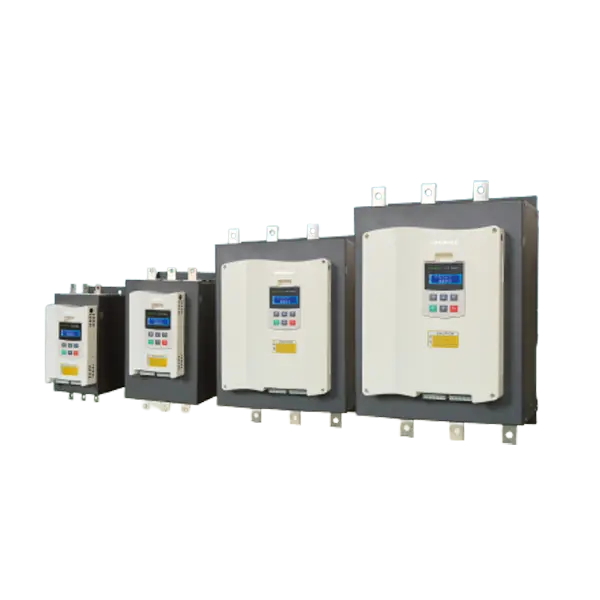
Imagine a large industrial motor starting up. Without any control, it instantly draws a massive surge of electricity and slams its connected machinery into motion with a jarring jolt. This harsh start isn’t just rough on the equipment it‘s costly, inefficient, and stressful for your entire electrical system. This is precisely the problem a Motor Soft Starter is designed to solve. It is an essential control device that manages a motor‘s startup sequence, providing a smooth, controlled ramp-up to full speed instead of an abrupt, damaging shock.
Solving the Core Problems of Direct-On-Line Starting
The primary reasons for using a Motor Soft Starter stem directly from the drawbacks of a traditional, uncontrolled start:
1. Reduce Inrush Current: They limit the initial startup current surge from 6-10x down to 2-4x the motor’s normal current, preventing voltage dips, protecting transformers, and avoiding high utility charges.
2. Prevent Mechanical Shock: By ensuring a smooth, linear acceleration, they protect drivetrain components like couplings, belts, and gears from damaging torque spikes, reducing wear and extending equipment life.
3. Enable Controlled Stopping: Many models offer a soft stop function, gradually ramping down the motor to prevent issues like liquid hammer in pipes or product spillage on conveyors.
Key Advantages and Operational Benefits
Beyond solving the core startup problems, integrating a soft starter delivers tangible benefits:
◆Improved System Reliability: By reducing electrical and mechanical stress, you enhance the overall reliability of both the motor and the driven equipment.
◆Cost-Effective Protection: It is often a more economical and simpler solution than a Variable Frequency Drive for applications that only require controlled starting and stopping, not speed variation.
◆Simple Integration: Modern soft starters are compact and relatively straightforward to install and set up, often requiring only basic adjustments to the acceleration ramp time.
Ideal Applications: Where Do You Need a Soft Starter?
Consider a soft starter essential for any motor-driven application that suffers from the “jolt and surge” of a hard start. Common use cases include:
◆Centrifugal Pumps: Prevents water hammer and protects pump impellers and seals.
◆Fans and Blowers: Eliminates the belt-slipping jerk and reduces stress on fan bearings.
◆Conveyor Systems: Provides smooth acceleration to prevent product spillage and belt damage.
◆Compressors: Reduces the massive torsional stress on compressor mechanisms during startup.
◆Crushers and Mixers: Manages the high-inertia start of heavy mechanical loads.
Making the Decision: Is a Soft Starter Right for You?
If your motor application experiences any of the following issues, a soft starter is likely the right solution:
◆Frequent trips of circuit breakers during motor startup.
◆Noticeable lights dimming when a large motor turns on.
◆Excessive wear on mechanical components like belts, chains, or gearboxes.
◆A process that would benefit from a gentler start and stop cycle.
Using a Motor Soft Starter is a smart investment in system longevity, operational smoothness, and electrical stability. It addresses the inherent violence of a standard motor start in a direct and efficient way, protecting your capital equipment from wear and your electrical network from disturbance. For applications that run at full speed once started, it remains one of the most effective and reliable methods to ensure a gentle, controlled beginning and end to your motor’s operation.
Post time: Jan-22-2026