

Choosing between a motor soft starter and a VFD affects motor life, electrical demand, energy costs, and process performance. Both offer smoother starting than direct-on-line, but serve different purposes. A soft starter controls motor starting and stopping, while a VFD also controls running speed. The choice depends on whether you need fixed-speed operation or continuous speed control.
What Is a Motor Soft Starter?
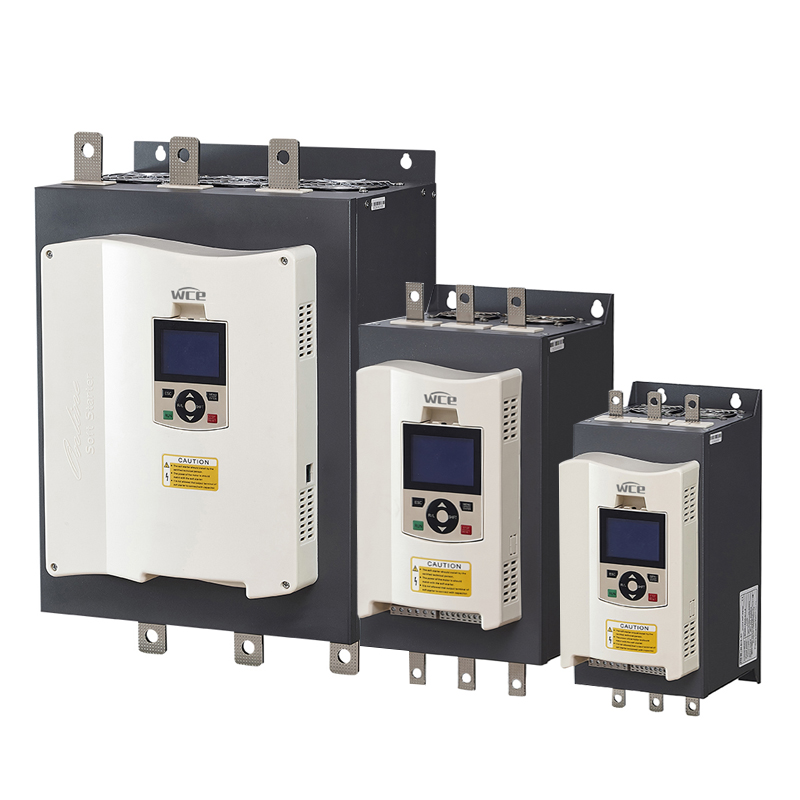
A motor soft starter gradually increases voltage to the motor during startup, using SCRs to limit inrush current and reduce sudden torque. This protects belts, couplings, gearboxes, bearings, pipes, and the electrical supply. Once the motor reaches full speed, full line voltage is applied, often through a bypass contactor to reduce heat and power loss. Soft starters adjust voltage but not frequency, so the motor runs at full rated speed after starting.
What Is a VFD?
A VFD, also known as an AC drive or inverter drive, changes the frequency and voltage delivered to a motor. Because motor speed depends largely on supply frequency, a VFD can control speed throughout operation.
In addition to smooth acceleration, VFDs can regulate flow, pressure, airflow, torque, conveyor speed, and temperature. They are widely used for variable-speed pumps, HVAC fans, cooling towers, mixers, extruders, and automated production lines.
Core Functional Differences
| Feature | Soft Starter | VFD |
|---|---|---|
| Main function | Controlled starting and stopping | Starting, stopping, and variable-speed control |
| Motor speed control | No; normally operates at full speed | Yes; adjusts speed during operation |
| Starting current reduction | Yes | Yes |
| Energy savings during operation | Limited | Potentially significant on variable-load systems |
| Cost and setup | Lower cost and simpler commissioning | Higher cost and more detailed setup |
The simplest distinction is this: a soft starter solves starting problems, while a VFD solves speed-control and process-control problems.
When to Choose a Soft Starter
Choose a soft starter when the motor needs to run at one constant speed, but direct-on-line starting causes high inrush current, voltage dips, mechanical shock, or water hammer.
It is often a practical choice for fixed-speed centrifugal pumps, conveyors, compressors, crushers, mixers, and fans. On pump systems, controlled acceleration and deceleration can reduce pressure surges in piping. On conveyors, it can reduce belt slip and sudden load movement.
A Motor Soft Starter is generally more economical than a VFD when variable speed is not needed. Modern models may also include overload protection, phase-loss detection, current limiting, stall protection, and communication functions.
When a VFD Is the Better Option
Choose a VFD when the process needs changing motor speed. This is especially important where flow, pressure, airflow, production rate, or torque must be adjusted during operation.
VFDs can reduce energy use on centrifugal pumps and fans because running these loads at a lower speed often requires much less power than running at full speed and restricting output with valves or dampers. Actual savings depend on the load profile, operating hours, and system design.
A VFD is also the better option for applications needing PID control, precise acceleration, multiple speed settings, PLC or SCADA integration, or controlled torque at low speed.
Cost, Complexity, and Application Comparison
Soft starters cost less, with simpler wiring and commissioning. They suit applications needing reduced startup stress without speed changes. VFDs cost more but offer far greater control, often requiring line reactors, harmonic mitigation, shielded cables, output filters, or extra grounding. VFDs also demand care with long motor cables and older motors due to voltage spikes and insulation stress.
For fixed-speed equipment, a soft starter usually offers better cost-to-benefit. For pumps, fans, or production equipment with varying demand, a VFD can justify its higher price through energy savings and improved process control.
Motor Soft Starter Sizing Tips
Select a starter using the motor’s full-load current, supply voltage, load type, starting duty, ambient temperature, and number of starts per hour. Do not select a unit by horsepower alone.
High-inertia loads and heavily loaded conveyors may need a higher-duty starter because reduced voltage also reduces available torque. Review the manufacturer’s application ratings and confirm that the motor can accelerate the connected load within the required time.
Motor Soft Starter Single Phase: What to Know
Most industrial soft starters are designed for three-phase induction motors. A “motor soft starter single phase” solution is less common because single-phase motors use different capacitor and winding arrangements.
Before using a starter on a single-phase motor, verify compatibility with the motor manufacturer. In applications requiring variable speed, replacing the motor with a three-phase model and using a VFD may be a more flexible solution.
FAQ
Can a soft starter control motor speed?
No. A soft starter controls voltage during starting and sometimes stopping, but it does not vary frequency. Use a VFD for ongoing speed control.
Is a soft starter cheaper than a VFD?
Usually, yes. Soft starters have a lower purchase price and simpler installation. However, a VFD may offer better long-term value where variable speed reduces energy use or improves production control.
Can I replace a VFD with a soft starter?
Only if the process does not require speed control, pressure regulation, flow adjustment, or other advanced drive functions.
In summary, a Motor Soft Starter is the right choice for reducing starting current and mechanical stress on fixed-speed motors. A VFD is the better investment when motor speed must adapt to changing process demand. Evaluate the load, operating conditions, control requirements, and total ownership cost before making a final selection.
Post time: Sep-03-2026